Alumni in Focus: Jeffrey Gorsky, B.A. ‘74, J.D. ‘77
January 8, 2026

CCAS and GW Law alumnus Jeffrey Gorsky, B.A. ‘74, J.D. ‘77, reflects on his 36-year career with the State Department and shares how his roots in the GW area shaped his professional and post-retirement pursuits. Jeffrey now dedicates his time to teaching and writing and has served as a mentor for Law students.
‘At law school, I learned that one of the most important factors in law is equity. Both in law and diplomacy, it is important to reach a result that is not just supported by precedent but is the fairest path available, and to also focus on narrative–justifying decisions by telling a clear and sympathetic story.’
Jeffrey Gorsky
B.A. ‘74, J.D. ‘77
Where did you grow up, and how has your background influenced you today?
I spent much of my life in the GW area. I was born in Columbia Hospital on 25th and L St, went to high school in Silver Spring, got my B.A. and J.D. at GW, then spent 36 years working in Foggy Bottom at the State Department (although as a foreign service officer I also served in Medellin and Bogota, Colombia during the Pablo Escobar years, as well as Bilbao, Spain, and Havana, Cuba).
Did you receive a scholarship at GW? How did it help you succeed?
I had an almost full undergraduate scholarship. I was the first generation in my family to attend college. My grandparents were immigrants from Ukraine–one was a sweat shop sewer and the other a delivery truck driver. My father’s only criteria for what school to choose was that it had to cost the same as the University of Maryland, and with my scholarship, GW met that standard.
Tell us about your current professional role and how it excites you.
After 36 years in the State Department and five years as Senior Counsel for the immigration law firm BAL, I’m now officially a retiree. I love that I can now focus on teaching and writing. I wrote a history of the Jews of Spain, titled Exiles in Sepharad: The Jewish Millenium in Spain, and I teach that history. I’ve also written a sci-fi novel titled The Dark Forever, a space opera about dark matter and the Kabbalah, which is scheduled for a July 2026 release.
What accomplishment are you most proud of personally or professionally and why?
At the State Department, I was an expert on immigration law and even received a Superior Honor award for writing a regulation that allowed diplomats to bring in their same-sex partners, working around the legal prohibition at the time against recognizing same-sex marriages. I also got the President’s Award from the International Outlaw Motorcycle Gang Investigator’s Association for writing a rule that allowed for visa restrictions on members of criminal bike gangs.
What is your only-at-GW moment? In other words, what is an experience/opportunity you believe GW provided you access to?
I was always a big film buff, and GW’s location was great for a film education. It was walking distance from the AFI–then located in the Kennedy Center–and from theaters that specialized in repertory and art films, such as the Circle Theater, which was owned by the Pedas brothers who would produce the Coen Brother movies, the Biograph and the Key. Alex Trebek once told me that my wife let me watch too many movies!
What is a piece of advice you would offer to students seeking to pursue your field of work?
At law school, I learned that one of the most important factors in law is equity. Both in law and diplomacy, it is important to reach a result that is not just supported by precedent but is the fairest path available, and to also focus on narrative–justifying decisions by telling a clear and sympathetic story.
Was there a standout course, professor, or organization from your time as a student that inspired your career path?
I was an English Major and my favorite teacher was Judith Plotz, who gave me a great background on 19th century literature. While it had no direct influence on my career as an immigration lawyer, both with the State Department and private practice, or as a diplomat and foreign service officer, it did help when I turned to writing history and fiction.
Is there anything you’d like to share with the GW community?
I’m married to a Brazilian and have two daughters with advanced degrees (but not from GW–they grew up in Arlington and GW was too close to home for them). I also speak Spanish and Portuguese.
How do you give back to the GW community?
I mentored several GW law students.
What is a fun fact about you that you’d like to share?
I was a winner on the Kennedy High School It’s Academic team, and went on in the mid-90s to win on Jeopardy.
Author Spotlight: The Dark Forever
Dark matter. Kabbalah. Artificial intelligence. An interstellar mystery—and a captain caught between science, spirituality, and survival.
Aug 13, 2026
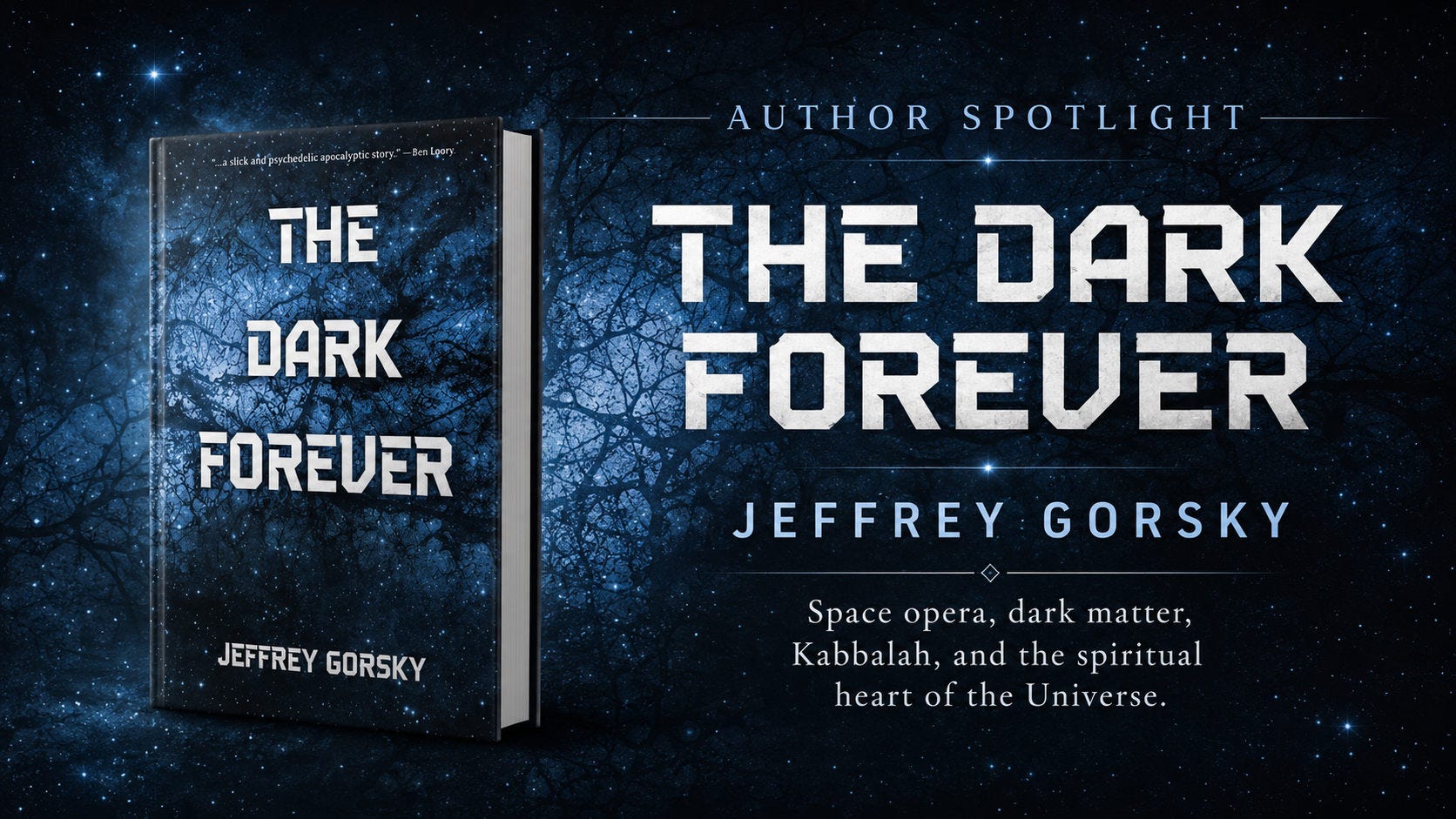
In this Author Spotlight, we go behind The Dark Forever, a speculative space opera that takes readers from the near future to the spiritual heart of the Universe. Its author talks about the unlikely connection between dark matter and Jewish mysticism, the science fiction that shaped the novel, the challenge of writing transcendence, and why sometimes the best reason to write a book is simply to tell a compelling story.
About the Book
1. For readers discovering The Dark Forever for the first time, how would you describe the novel in your own words?
The Dark Forever is a speculative fiction space opera, a thriller set in the near future where a young woman, Lucy Howard, is hired to captain an interstellar ship powered by a mysterious device.
She has to face two threats—the aliens of the “Hive” planet and the challenge of facing off against her boss, a libertarian IT billionaire whose ultimate ambition is to colonize Mars.
To survive, she has to explore the interface of science and religion and travel into the spiritual heart of the Universe.
2. What was the first spark that inspired this story? Was it an image, a scientific concept, a philosophical question, or something else entirely?
The inspiration came from the COVID epidemic. I had just finished eight years researching and writing an academic history, Exiles in Sepharad: The Jewish Millennium in Spain, and was burnt out and ready to take a break.
But the shock of dealing with the epidemic, and with a worldwide political situation I found depressing—at the time, I was working as Senior Counsel in an immigration law firm, dealing with a very difficult period for immigration lawyers—made me feel I needed an escape.
As a lifelong sci-fi fan, I thought the best escape would be to write an adventure set in outer space.
3. The novel blends space opera with ideas about dark matter and the Kabbalah. What drew you to bringing science and spirituality together in one story?
I’ve long been fascinated by the idea of dark matter and dark energy. I grew up witnessing the great advances in science, thinking that we were moving toward a comprehensive scientific understanding of the Universe, but scientists now believe that 95 percent of the Universe is made up of unknown stuff they can’t explain.
As for the Kabbalah, I had to study the various mystical works that collectively are called the Kabbalah for my history, since many of the ideas of the Kabbalah came from the Spanish Jews. My history book has a chapter on The Zohar, or The Book of Splendor, a canonical work that was published in 13th-century Spain.
This dual interest led me to see a link between dark matter and concepts in the Kabbalah. While I came up with the idea myself, I found that other people have seen the same links, and there are nonfiction books and papers exploring this connection.
4. Captain Lucy Howard finds herself facing impossible choices. What makes her the right person to stand at the center of this story?
I think Lucy’s strength comes out of her inexperience and insecurity, as well as her empathy, sense of duty, and personal courage.
She is someone ready to work with her group, explore unconventional paths, and make whatever sacrifices are needed to save her friends and crewmembers.
Behind the Writing
5. Were there any books, scientists, philosophers, or spiritual traditions that influenced your writing?
Since this is sci-fi, I was influenced by old TV. I grew up watching Star Trek, and that had an influence on my writing.
I saw Lucy and Martha as a gender-reversed Kirk and Dr. McCoy, and there are elements of the holodeck in the book. My inspiration for the Hive came from an old Outer Limits episode.
6. Did you discover anything during your research that completely changed how you viewed the Universe—or the story itself?
What changed my view of the story was the characters in the book.
My plot evolved significantly as I started to think about my characters’ backstories and motivations. I think characterization is the most important element of fiction, which is why my plot evolved and grew with my characters.
7. Was there a particular scene that was especially exciting—or especially difficult—to write? Why?
I found the last chapter before the epilogue to be a fascinating challenge.
I had to describe transcendence—to find specific, concrete ways to credibly describe an ineffable, indescribable experience.
Themes & Big Questions
8. Beyond the action and adventure, what questions did you hope readers would think about after turning the final page?
I like Mark Twain’s quote from Huck Finn:
“Persons attempting to find a motive in this narrative will be prosecuted; persons attempting to find a moral in it will be banished; persons attempting to find a plot in it will be shot.”
Of course, Huck Finn has motives, morals, and a plot. But story and character are primary.
My book, while emphasizing story and character, tries to grapple with a number of issues, including the AI apocalypse, epidemic threats, and environmental protection.
I mainly wanted to counter the materialist, reductionist ideas popular with some of the libertarian leaders of our IT economy.
Incidentally, the prominence of one of those leaders today might lead some people to think he was the model for Walter Monk, but actually I modeled him after a number of prominent industry figures—there are several rich libertarians who want to colonize Mars.
9. If readers could take away just one idea from The Dark Forever, what would you hope it would be?
Again, I mainly wanted to provide a counter to the materialistic ideas that seem to drive some of our IT billionaire class.
As for the primary high-concept driver of the book—the link between the scientific and spiritual worlds—I thought it was an interesting idea to play with, but I mainly viewed it as my “MacGuffin,” Hitchcock’s word for a plot device.
Getting to Know the Author
10. If you could visit one fictional world—from your own novel or anyone else’s—which would you choose and why?
Any fictional setting with good views, good food and drinks, and a place to put up my family.
11. What’s one science fiction novel or author you think every space-opera fan should experience?
Avram Davidson is one of the greatest sci-fi/fantasy writers. He is underappreciated, in part because his strength is in his short fiction—he didn’t have the discipline for long-form fiction.
He wrote few space operas, but one I would recommend is the short story “Now Let Us Sleep,” which deals with genocide.
I would also recommend his flash fiction “And Don’t Forget the One Red Rose,” which reads like a collaboration between O. Henry and Jorge Luis Borges.
12. When you’re not writing, what hobbies or interests keep your curiosity alive?
I’m a buff of classical music and film. When I won on Jeopardy!, Alex Trebek told me that my wife let me watch too many movies.
I teach classes to seniors at American and George Mason University and have developed classes on the Jews of Spain, silent film comedies, and the Mozart/Da Ponte operas.
For the 250th anniversary celebration, I taught a course on The Marriage of Figaro and the American Revolution—the author of the Figaro play, Beaumarchais, was actively involved in assisting the American rebels.
Just for Fun
13. You can captain any spaceship in science fiction. Which one are you choosing?
Any spaceship I can think of, including the unnamed ship in my book, involves too much hazard pay for my taste.
But the worst assignment would be on the Nostromo.
14. Coffee on Earth or tea while watching a nebula from orbit?
Coffee and nebula.
15. Finally, what’s next? Can readers expect more adventures from you in the future?
There could be a sequel to The Dark Forever.
Not on another planet—that would be too same old, same old. But it could be interesting to see what would happen if Monk was resurrected and the old crew had to face the threat of the Hive planet here on Earth.
About The Dark Forever
A near-future space opera blending scientific mystery, spiritual inquiry, and interstellar adventure, The Dark Forever follows Captain Lucy Howard as she confronts an alien threat, the ambitions of a powerful billionaire, and questions that push beyond the boundaries of what science alone can explain.
Ready to enter The Dark Forever?
Click HERE to learn more
Enjoy discovering the stories behind the stories? Subscribe to Between the Lines for more author spotlights, interviews, book news, and conversations with the writers behind the books.